April 1, 2026
Many homeowners attempt tree pruning themselves, often with good intentions. However, without proper knowledge, do-it-yourself tree trimming can lead to severe, long-lasting damage, compromising a tree’s health, structural integrity, and even its lifespan. Understanding the risks involved is the first step in protecting your valuable landscape investment.
Key Takeaways
- Improper pruning, like topping or flush cuts, can severely damage trees, inviting decay and structural weakness.
- Trees do not ‘heal’ wounds; they compartmentalize decay (CODIT), a process hindered by incorrect cuts.
- Removing more than 25% of a tree’s canopy at once stresses its energy reserves, leading to weak regrowth and vulnerability.
- Pruning timing is crucial and often species-specific, with some trees requiring special considerations to prevent disease spread.
- Professional arborists adhere to ANSI A300 standards, ensuring proper techniques like the ‘Three-Cut Method’ for optimal tree health.
- Hiring professionals prevents costly long-term damage and promotes tree longevity.
Can a Tree Die from Improper Pruning? Understanding CODIT
Improper pruning can indeed kill a tree, though the process might be slow. Trees are living organisms with complex biological systems that react to every cut. Unlike humans, trees do not ‘heal’ wounds by regenerating tissue across the cut; instead, they compartmentalize decay. This natural defense mechanism, known as Compartmentalization of Decay in Trees (CODIT), allows a tree to wall off injured or infected areas, preventing the spread of decay into healthy wood. Incorrect cuts disrupt this vital process, leaving the tree vulnerable.
What is Compartmentalization of Decay in Trees (CODIT)?
CODIT is a tree’s natural defense system against the spread of disease and decay. When a tree is wounded, it forms chemical and physical barriers to isolate the damaged tissue. This process creates a ‘wall’ around the injury, protecting the healthy wood. The effectiveness of CODIT largely depends on the type and location of the wound.
How Improper Cuts Impact CODIT
When a tree is pruned correctly, the cut is made outside the branch collar, allowing the tree to form a callus and effectively seal the wound. Improper cuts, such as flush cuts or leaving stubs, damage the branch collar or leave open pathways for pathogens. This compromises the tree’s ability to compartmentalize, leading to extensive internal decay that can weaken the tree structurally and ultimately lead to its demise.
Common DIY Pruning Mistakes and Their Damaging Effects
Many common DIY pruning errors stem from a lack of understanding of tree biology and proper cutting techniques. These mistakes often lead to more than just aesthetic problems; they create entry points for pests and diseases, weaken the tree’s structure, and shorten its lifespan.
| Pruning Mistake | Description | Immediate Impact | Long-Term Consequences |
|---|---|---|---|
| Topping | Cutting main branches back to stubs, removing large parts of the canopy. | Severe stress, shock, and energy loss. | Weak regrowth, decay, structural failure, higher risk of falling branches. |
| Lion’s Tailing | Removing inner branches and leaving foliage only at the ends. | Sunburn, wind stress, and reduced leaf function. | Weak branch structure, breakage risk, and reduced overall health. |
| Flush Cut | Cutting too close to the trunk and removing the branch collar. | Damages natural healing tissue. | Large wounds, internal decay, disease entry. |
| Stub Cut | Leaving a short piece of the branch after cutting. | Prevents proper wound closure. | Decay spread, dead wood, pathogen entry into trunk. |
Topping: The Mutilation of Trees
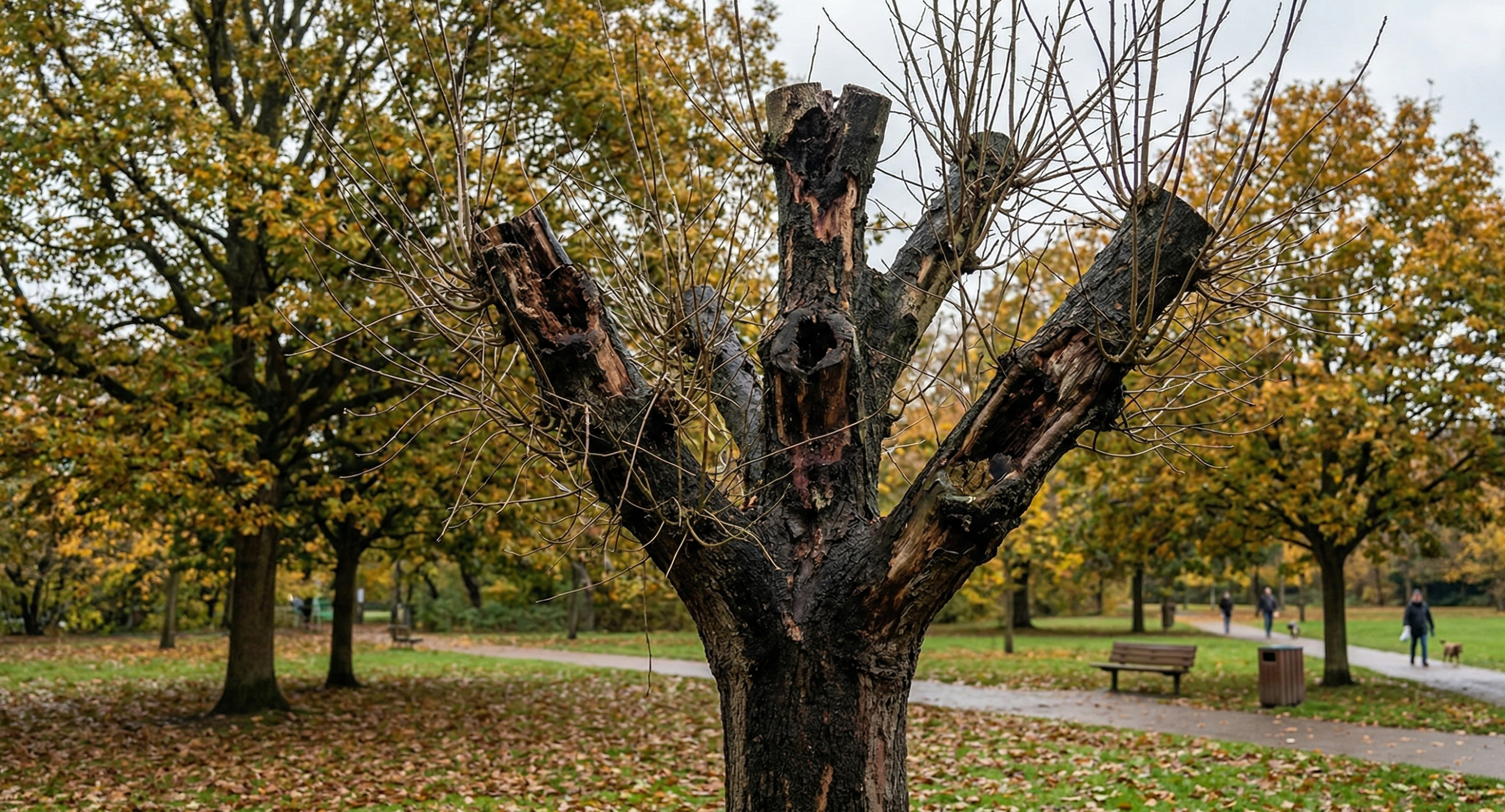
Topping is one of the most destructive pruning practices. It involves cutting large branches back to stubs, often indiscriminately, without regard for tree structure or health. This practice removes a significant portion of the tree’s energy-producing canopy, starving the tree and triggering a survival response.
- Starvation and Stress: Removing too much canopy reduces the tree’s ability to photosynthesize, leading to severe stress and energy depletion.
- Weak Regrowth: Topping causes a flush of rapidly attached shoots called ‘water sprouts’ or ‘suckers’. These sprouts are poorly connected to the main branch and prone to breaking, especially in storms.
- Decay and Disease: Large, open wounds created by topping rarely seal properly, becoming entry points for fungi, insects, and decay-causing organisms. This decay can spread throughout the tree’s core.
- Increased Hazard: The weak, rapid regrowth and internal decay make the tree structurally unsound, significantly increasing the risk of branch failure.
Lion’s Tailing: Weakening the Structure
Lion’s tailing involves removing all the inner branches and foliage along a limb, leaving only a small tuft of leaves at the end. This practice makes the tree look like a lion’s tail, hence the name. While it might seem to ‘clean up’ the tree, it has severe consequences.
- Sunburn: Exposing previously shaded bark to direct sunlight can cause sunscald, damaging the cambium layer.
- Wind Damage: Removing interior branches shifts the weight to the ends of the limbs, increasing leverage and making them more susceptible to breaking in high winds.
- Reduced Energy Production: The removal of healthy, interior foliage reduces the tree’s overall photosynthetic capacity, weakening it.
- Weak Branch Structure: It promotes weak, elongated growth at the branch tips, further exacerbating structural instability.
Flush Cuts vs. Proper Cuts: Understanding the Branch Collar
Understanding the anatomy of a tree, especially the branch collar, is essential for making proper cuts. The branch collar is the swollen area at the base of a branch where it attaches to the trunk or a larger limb. It contains specialized cells critical for wound closure.
- Flush Cut: This involves cutting a branch too close to the trunk, removing the branch collar entirely. Flush cuts create large wounds that struggle to seal, leaving the tree vulnerable to decay. The tree’s natural defense mechanisms are severely compromised.
- Proper Cut (Target Cut): A proper cut is made just outside the branch collar, preserving this vital area. This allows the tree to form a callus over the wound, effectively sealing it off and preventing the entry of pathogens. Expert guidance on the Three-Cut Method describes how to remove larger branches safely to prevent bark tearing.
Stub Cuts: Inviting Decay
Leaving a stub, a short section of a branch, after pruning, is another common mistake. Stubs prevent the tree from properly sealing the wound. Without the branch collar intact, the stub will eventually die back, creating an open pathway for decay to enter the main stem. This decay can spread deep into the trunk, compromising the tree’s structural integrity.
The Critical ‘How Much’: Over-Pruning and Tree Stress
One of the most frequent questions homeowners ask is, ‘How much of a tree can I safely cut at once?’ The answer is critical for tree health. Over-pruning, or removing an excessive amount of foliage, significantly stresses a tree. A general rule of thumb, supported by arboricultural science, is to never remove more than 25% of a tree’s live canopy in a single pruning cycle. Exceeding this limit can have severe repercussions.
- Energy Depletion: Leaves are a tree’s food factories. Removing too many leaves at once drastically reduces the tree’s ability to produce energy through photosynthesis. This depletes its stored energy reserves, making it vulnerable.
- Shock and Decline: Trees can go into shock from severe pruning, leading to stunted growth, reduced vigor, and increased susceptibility to pests and diseases.
- Water Sprout and Sucker Growth: As a survival mechanism, severely pruned trees often produce an abundance of fast-growing, weakly attached shoots called water sprouts (on branches) and suckers (from the base or roots). These growths are structurally weak and require more pruning, creating a cycle of continuous maintenance.
- Compromised Aesthetics: While initially intended to improve appearance, over-pruning often results in an unnatural, disfigured tree that takes years to recover. Research on avoiding excessive canopy removal highlights the importance of preventing such stress.
Timing Is Essential: Species-Specific Pruning and Disease Prevention
The timing of pruning is just as important as the technique. General advice often suggests pruning in winter, during dormancy. While this is true for many species, it is not a universal rule. Different tree species have optimal pruning windows, and some require specific timing to prevent disease spread.
Dormant Season Pruning: The General Rule
For most deciduous trees, late fall to early spring, when the tree is dormant and leafless, is ideal. This timing allows for better visibility of the tree’s structure and reduces the risk of disease transmission, as many pathogens are less active in colder months. It also minimizes sap bleeding in certain species.
Critical Exceptions: Preventing Oak Wilt and Other Diseases
However, some trees should be pruned at specific times to protect them from particular threats. For example, Oak trees in the local area should generally not be pruned between April and October. This is because fresh wounds on oaks during these warmer months can attract sap-feeding beetles that transmit the fungal disease Oak Wilt. This disease can be fatal to oak trees. Similarly, flowering trees are often pruned after they bloom to preserve the current season’s flowers.
The Role of Local Expertise
Understanding these nuances requires expertise. A professional arborist can assess your specific tree species and local environmental conditions to determine the safest and most beneficial pruning schedule.
The Professional Standard: Why ANSI A300 Matters
When considering tree care, especially pruning, it is crucial to understand the standards that guide professional arborists. The ANSI A300 Standards are the industry-recognized guidelines for tree care operations, including pruning. These standards represent the consensus of experts on proper tree care practices, ensuring safety, tree health, and structural integrity. Public resources providing access to information on ANSI A300 Pruning Standards serve as a guide for proper tree care.
- Ensuring Tree Health: ANSI A300 standards dictate techniques that promote a tree’s long-term health, such as making proper cuts that encourage wound closure and minimizing stress.
- Promoting Safety: These standards include guidelines for safe work practices, protecting both the tree and the people working on it, as well as property owners.
- Preventing Damage: By adhering to ANSI A300, professionals avoid harmful practices like topping or lion’s tailing, which are explicitly deemed unacceptable.
- Consistency and Quality: Following these standards ensures a consistent, high level of quality in tree care across the industry. When professionals prune your trees, you can be confident that methods align with these rigorous benchmarks.
The Long-Term Consequences of DIY Damage
The immediate damage from improper DIY pruning is often visible, but the long-term consequences can be far more severe and costly. What might seem like a small mistake today can lead to significant problems years down the line.
- Extensive Decay and Cavities: Incorrect cuts create open wounds that become entry points for fungi and bacteria. Over time, this leads to internal decay, forming large cavities that compromise the tree’s structural integrity and make it hollow.
- Structural Failure: Trees weakened by decay, weak water sprout regrowth, or poor structure from lion’s tailing are prone to limb breakage or complete tree failure, especially during storms. This poses a significant safety risk to people and property.
- Increased Susceptibility to Pests and Diseases: Stressed or wounded trees are more vulnerable to insect infestations and various diseases. Improper pruning can turn a healthy tree into a magnet for problems.
- Premature Decline and Death: The cumulative effects of stress, decay, and pest/disease attacks can lead to the premature decline and eventual death of the tree, even if it initially survived the pruning.
- Higher Future Costs: While DIY pruning might seem to save money initially, the long-term costs of addressing decay, removing hazardous limbs, treating diseases, or eventually removing a dead tree are often far greater. Professional tree care is a cost-effective choice for long-term tree health. Learn more about the general practice of pruning.
Protect Your Trees: Choose Professional Pruning
Protecting your trees from the hidden dangers of improper DIY pruning requires knowledge and skill. Professional tree pruning services ensure your trees receive the best possible care. Experienced arborists understand tree biology, adhere to ANSI A300 standards, and employ techniques that promote health, safety, and longevity. Do not risk the health of your valuable trees with guesswork. Contact an arborist today for a professional assessment and pruning plan.
Frequently Asked Questions
Can a tree die from improper pruning?
Yes, improper pruning can kill a tree by removing too much canopy, making incorrect cuts that invite disease, or stressing its energy reserves. Trees do not ‘heal’ like humans; they seal wounds, and bad cuts prevent this process.
What is ‘topping’ a tree and why is it bad?
Tree topping involves cutting back main branches to stubs, removing a large portion of the tree’s crown. This practice severely stresses the tree, promotes weak, rapid regrowth, and leaves large wounds susceptible to decay and disease.
What does a ‘flush cut’ do to a tree?
A flush cut removes a branch too close to the trunk, cutting into the branch collar. This area contains specialized cells vital for sealing the wound. A flush cut damages these cells, hindering the tree’s natural defense mechanism against decay.
How much of a tree can I safely cut at once?
Generally, you should not remove more than 25% of a tree’s total canopy in a single pruning cycle. Exceeding this limit can severely stress the tree, depleting its energy reserves and making it vulnerable to pests and disease.
When is the best time to prune trees?
The best time to prune most trees is during their dormant season, typically late fall to early spring. However, specific species or disease concerns (like Oak Wilt) require different timing. Always research your tree species.
How can I tell if my tree has been improperly pruned?
Signs include large, unsealed wounds, excessive water sprouts or suckers, dieback of branches, unusual branch angles, or visible decay. If you notice these, a professional arborist should assess your tree.
Why should I hire a professional arborist for tree pruning?
Hiring a professional ensures your trees are pruned according to industry standards like ANSI A300. Arborists understand tree biology, proper cutting techniques, and the specific needs of various species, thereby preserving tree health and structural integrity.
Professional Tree Care Protects Long-Term Tree Health and Property Safety
Understanding tree health science and following professional pruning standards helps prevent long-term damage and safety risks. Improper DIY pruning can create permanent structural weakness, increase disease risk, and shorten the lifespan of your trees.
Working with trained arborists ensures pruning is done correctly based on tree species, structure, and environmental conditions. Albemarle Landscapes and Tree Service provides precision pruning, health-focused tree care, and industry-standard practices designed to protect tree longevity and overall landscape safety.