September 16, 2026
Key Takeaways
- Cabling and bracing are structural support systems that can reduce the risk of limb or trunk failure in mature trees.
- These systems do not make a tree storm-proof, but may help manage specific structural weaknesses.
- Bracing is most often recommended for trees with included bark, co-dominant stems, or prior storm damage.
- A certified arborist should assess a tree before recommending cabling or bracing, since not every tree is a good candidate.
- Regular inspection of existing cable and brace systems is important, especially after major Outer Banks storms.
Mature trees are one of the defining features of many Outer Banks (OBX) properties, offering shade, wind protection, and decades of established growth that cannot be quickly replaced. When a valuable tree shows signs of structural weakness, whether from a split trunk, a heavy leaning limb, or a history of storm damage, homeowners often want to know whether something can be done to protect it rather than remove it. Cabling and bracing are two of the tools an experienced tree service firm in Kitty Hawk, North Carolina will use to provide additional structural support, but they are not a fix for every situation.
This article explains what cabling and bracing involve, when they may be appropriate for Outer Banks trees facing significant wind exposure, and what homeowners should understand about the limits of these systems.
What Cabling and Bracing Actually Do
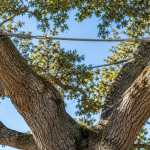
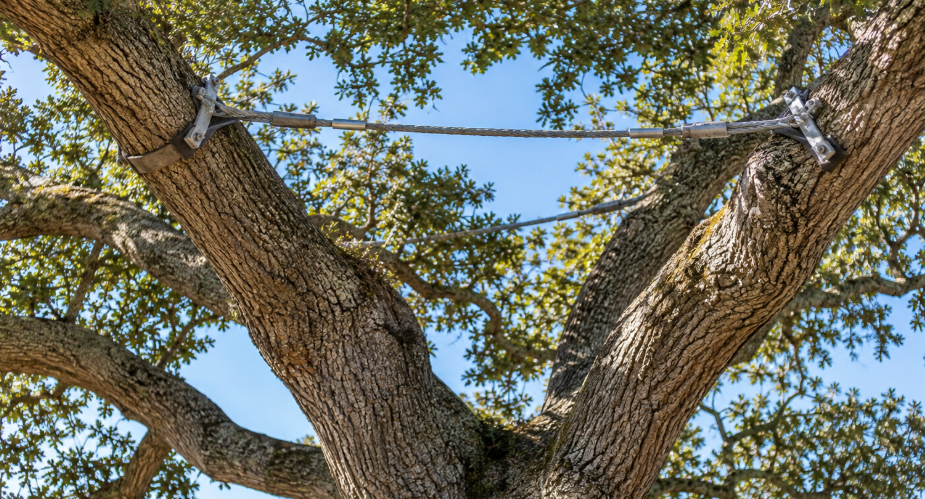
Cabling involves installing a flexible steel cable, or in some systems a synthetic support line, high in a tree’s canopy to limit how far two major limbs or stems can move independently of each other. This is typically used to reduce stress on a weak branch union, particularly where two large limbs grow from a similar point on the trunk, a structure known as a co-dominant stem.
Bracing, by contrast, generally involves installing a rigid steel rod through a trunk or major limb to provide more direct support, often used in cases involving a split or partially failed union where additional rigidity is needed close to the point of weakness.
Both systems are designed to redistribute mechanical stress across a tree’s structure, reducing the load placed on the weakest point during wind events. They are not designed to hold up an otherwise failing tree indefinitely, and they work best when installed as part of a broader plan that also includes canopy management and ongoing monitoring.
Why Wind Exposure Matters So Much on the Outer Banks
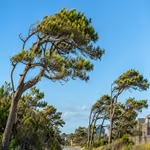
Barrier island properties face a level of sustained and storm-driven wind exposure that inland trees typically do not experience. Even trees that are otherwise healthy can develop structural weaknesses over years of repeated wind loading, particularly if they have a split or narrow branch union, extensive one-sided canopy growth from prevailing winds, or prior damage from a previous storm that was never fully addressed.
This cumulative stress is part of why structural assessment matters more for Outer Banks trees than it might in a more sheltered inland setting. A weakness that might remain stable for years in calmer conditions can become a significant failure risk once exposed to repeated tropical storm or hurricane-force wind events.
When Bracing or Cabling May Be Appropriate
Not every mature tree needs structural support, and installing cabling or bracing without a clear structural reason is generally not recommended. Arborists typically consider these systems for trees showing specific warning signs.
- Included bark, where two limbs grow so closely together that bark becomes trapped in the union rather than forming solid wood connection, creates a naturally weaker point that is more prone to splitting under wind load.
- Co-dominant stems, where a tree has two or more major trunks of similar size rather than one clearly dominant leader, often create structural imbalance that cabling can help manage.
- Previous storm damage, such as a partial split that has not fully failed, may sometimes be stabilized with bracing rather than requiring removal of the affected limb, depending on the severity and location of the damage.
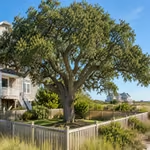
- Historically or aesthetically significant trees, particularly large legacy live oaks that homeowners are especially motivated to preserve, are sometimes good candidates for support systems even when the structural concern is moderate rather than severe.
When Bracing Is Not the Right Answer
Cabling and bracing are not appropriate for every structural issue, and a responsible arborist will say so when the risk is too significant to manage this way.
- Trees with extensive internal decay, particularly in the lower trunk or root flare, are generally poor candidates, since support systems address canopy-level stress but cannot compensate for a compromised base.
- Trees positioned very close to a home, driveway, or frequently used outdoor space may also present too much risk even with support systems installed, particularly if a full failure, rather than a partial one, would have serious consequences.
In these cases, removal or significant canopy reduction may be a safer long-term recommendation than relying on cabling alone.
The Assessment Process
Before recommending cabling or bracing, a qualified arborist should conduct a detailed structural assessment of the tree. This typically includes –
- examining the specific branch unions or trunk areas of concern
- checking for signs of decay using visual inspection and sometimes more specialized tools, and
- evaluating the tree’s overall health, root condition, and surrounding site factors.
This assessment helps determine not only whether support systems are appropriate, but where exactly they should be installed and what type of system best addresses the specific weakness identified. A generic or one-size-fits-all approach to cabling is less effective than a plan based on the tree’s actual structural condition.
Installation Considerations
Cabling and bracing should be installed by a trained professional, since improper placement or tensioning can fail to provide adequate support or, in some cases, create new stress points elsewhere in the tree. Cable systems are typically installed high enough in the canopy to effectively limit limb movement while allowing the tree some natural flexibility to sway in wind, which is part of how healthy trees dissipate mechanical stress.
The specific hardware, cable gauge, and installation height depend on the tree’s size, species, and the nature of the structural concern being addressed. This is another reason why professional assessment matters more than a general rule of thumb for any given tree.
Ongoing Monitoring Is Essential
Installing a cable or brace system is not a one-time fix. Trees continue to grow, and existing support systems should be periodically inspected to confirm they are still appropriately tensioned and positioned as the tree’s canopy develops. This is especially important following major storms, when even a well-supported tree should be checked for new stress or movement in the previously identified weak points.
Homeowners with existing cable or brace systems on their property, whether installed by a previous owner or an earlier service provider, should have them inspected periodically rather than assuming the original installation remains adequate indefinitely.
Alternatives to Consider Alongside Bracing
Cabling and bracing are often most effective when combined with other structural management practices rather than used as a standalone solution.
- Canopy thinning can reduce wind resistance across a tree’s overall structure, lowering the load placed on a supported branch union during a storm without removing the limb entirely.
- Selective pruning of overextended or poorly attached secondary branches can also reduce weight in areas that place additional strain on a weak union.
- For trees with significant lean or root concerns rather than a canopy-level structural issue, soil and root zone management, such as addressing compacted soil or improving drainage, may be a more relevant intervention than canopy bracing.
- A comprehensive assessment typically considers all of these factors together rather than treating cabling as an isolated fix.
What Homeowners Should Expect From an Assessment Visit
During an on-site assessment, an arborist typically examines the tree from multiple angles, looking closely at the specific area of concern as well as the tree’s overall canopy balance and visible root flare. Some assessments may include sounding the trunk or major limbs to check for internal decay, and in certain cases, a resistance drill or similar tool may be used for a more detailed evaluation of specific areas.
Homeowners should expect a clear explanation of what the arborist found, what options are available given that finding, and a realistic sense of what any recommended support system can and cannot address. A thorough assessment should result in a specific recommendation tied to the tree’s actual condition, not a generic proposal applied without that context.
A Tool for Preservation, Not a Guarantee
Cabling and bracing can be a valuable option for homeowners hoping to preserve a mature or significant tree that shows a specific, manageable structural weakness. They are best understood as a way to reduce risk and extend a tree’s safe lifespan, not as a guarantee against failure during a severe storm. Extreme wind events can still damage or bring down even well-supported trees, and homeowners should weigh this reality when deciding between structural support and removal.
Albemarle Landscapes & Tree Service helps Outer Banks homeowners protect and preserve mature trees exposed to coastal winds and storms. Our experienced tree care team evaluates each tree’s structure, health, location, and surrounding conditions before recommending any work. When appropriate, we can provide professional cabling and bracing to help manage specific structural weaknesses.
Albemarle Landscapes & Tree Service also offers canopy reduction, trimming & pruning, and tree removal when those options are more suitable for the tree’s condition. Every recommendation is based on the individual tree rather than a one-size-fits-all approach. Our goal is to help homeowners make informed decisions while prioritizing tree health and property safety.
Frequently Asked Questions About Tree Bracing and Cabling in the Outer Banks (OBX), North Carolina
How long does a cabling or bracing system typically last?
This varies depending on the system, the tree’s growth rate, and environmental exposure, but periodic inspection and occasional adjustment are generally needed over the tree’s lifetime.
Does bracing mean a tree is completely safe in a storm?
No. Bracing and cabling reduce specific structural risks but cannot guarantee a tree will withstand every storm, particularly during severe hurricane-force winds.
How do I know if my tree needs bracing?
A certified arborist assessment is the best way to determine this, looking for signs such as included bark, co-dominant stems, or prior storm damage.
Can any tree be braced?
No. Trees with significant internal decay or those positioned where a full failure would pose serious risk may not be good candidates, and removal may be the safer recommendation.
Should existing cables be inspected after a storm?
Yes. Previously installed cable or brace systems should be checked after major storms to confirm they remain properly tensioned and that no new stress has developed.
Summary Checklist: Protecting Mature Trees through Bracing and Cabling from OBX Winds
| Evaluation Area | What to Confirm |
| Structural concern | Included bark, co-dominant stems, or prior storm damage identified |
| Tree condition | No significant internal decay in the trunk or root flare |
| Location risk | Proximity to structures, driveways, or frequently used spaces |
| Assessment | Detailed evaluation by a certified arborist before installation |
| System type | Flexible cabling versus rigid bracing appropriate to the weakness |
| Installation | Professional placement, tensioning, and hardware sized to the tree |
| Complementary care | Canopy thinning or pruning to reduce overall wind load |
| Ongoing monitoring | Periodic inspection, especially after major storms |
Final Advice
Cabling and bracing can be a useful way to extend the safe life of a mature or significant tree with a specific, identifiable structural weakness, particularly on a barrier island property facing repeated wind exposure. These systems work best when paired with a thorough arborist assessment, appropriate canopy management, and consistent follow-up inspection, and they are not appropriate for every tree, especially those with significant decay or a location where full failure would carry serious risk.
Albemarle Landscapes and Tree Service evaluates mature trees throughout Outer Banks properties to determine whether bracing, cabling, canopy reduction, or removal best fits each tree’s condition and the level of wind exposure the property experiences.