May 10, 2026
Key Takeaways:
- Hurricane preparation should ideally begin in late winter or early spring.
- Canopy thinning is vital to reduce the sail effect during high-velocity winds.
- End-weight reduction prevents long limbs from snapping under extreme torque.
- Root flare inspection ensures the tree’s foundation is stable in sandy OBX soil.
- Professional risk assessments identify internal decay that is invisible to the eye.
Living in the Outer Banks, North Carolina, means embracing the beauty of the Atlantic, but it also requires a deep respect for the power of the Atlantic. For homeowners from Corolla to Manteo, hurricane season is not an abstract concept; it is a recurring reality that demands proactive maintenance. While we often focus on shutters and generators, the most significant threat to a coastal property is often the very thing that provides its shade and character: the trees. Preparing your trees for hurricane season is a specialized science that balances the biological needs of the tree with the mechanical realities of 100-plus mph winds.
The Mechanics of Wind and the Sail Effect
The primary reason trees fail during an Outer Banks hurricane is the sail effect. A tree with a dense, unpruned canopy acts exactly like a sail on a boat. When hurricane-force winds hit a thick wall of foliage, the wind cannot pass through. Instead, it pushes against the entire surface area of the tree. This pressure is transferred down the trunk and into the root system.
In our sandy coastal soil, this pressure often exceeds the soil’s holding capacity, leading to windthrow, where the entire tree is uprooted. To mitigate this, professional arborists use a technique called canopy thinning. By selectively removing smaller branches within the interior of the tree, we create air windows. These gaps allow the wind to blow through the tree rather than against it, significantly reducing the load on the trunk and roots.
The Danger of End-Weight on Coastal Limbs
Live Oaks and many other coastal species in the Outer Banks (OBX) are famous for their long, horizontal-reaching limbs. While these provide an iconic aesthetic, they are structurally vulnerable during a storm. The further a limb extends from the trunk, the more leverage the wind has over it. During a hurricane, the weight of the rain-soaked leaves combined with the force of the wind can create enough torque to snap even a thick limb.
End-weight reduction is a critical component of storm prep. By strategically removing weight from the tips of these long branches, we move the center of gravity closer to the trunk. This makes the limb much more resilient and less likely to shatter or tear away from the main body of the tree, which often causes irreparable damage to the heartwood.
Identifying Hangers and Deadwood
The most immediate danger during a storm comes from what is already dead. Dead branches have lost their internal flexibility; they are brittle and lack the spring of live wood. In the high-velocity environment of a hurricane, these branches become high-speed projectiles.
Before the season begins in June, a thorough deadwooding is necessary. This involves removing any limbs that are already decaying or diseased. We also look for hangers branches that may have cracked during a previous nor’easter and are simply resting in the canopy. These are the first things to fly off when the wind picks up, and they are responsible for a significant portion of broken windows and roof punctures in Dare County, NC.
Structural Support: Cabling and Bracing
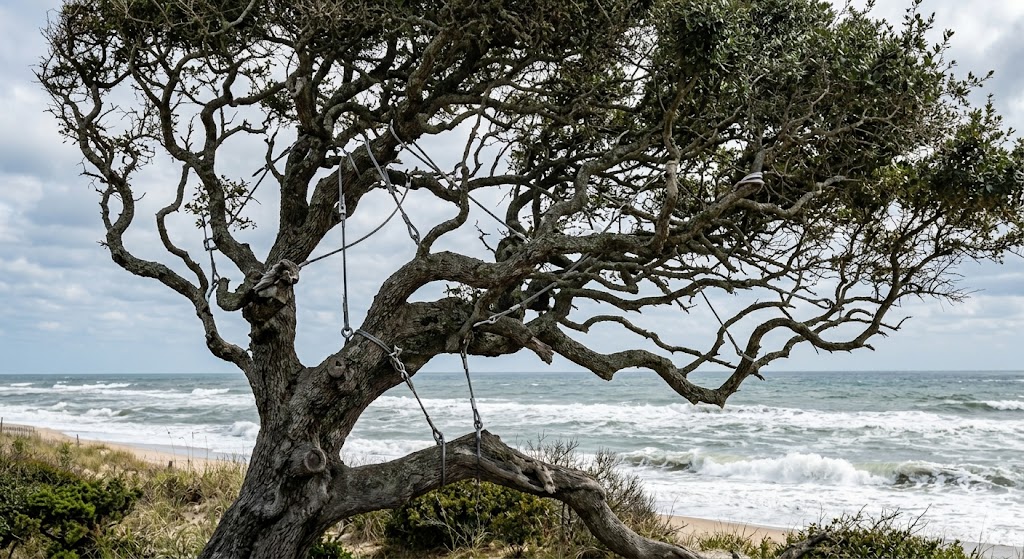
Not every at-risk tree needs to be removed. Many historic Live Oaks in the Outer Banks have structural flaws, such as co-dominant stems (two trunks growing from the same base) or deep V-shaped crotches. These areas are natural weak points where the tree is likely to split under the stress of a storm.
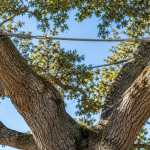
For these valuable trees, we use cabling and bracing. This involves installing high-strength steel cables between major limbs to limit their movement and provide supplemental support. Bracing involves threaded rods through the trunk to hold a split together. These systems are invisible from the ground but provide the necessary reinforcement to help a majestic tree survive a Category 2 or 3 storm that might otherwise destroy it.
Protecting the Root Flare and Sandy Foundation
The stability of an OBX tree is only as good as the sand it sits in. Unlike clay, sandy soil becomes a slurry when saturated by heavy hurricane rains. If a tree has a compromised root system, it has no chance of staying upright.
Homeowners should inspect the root flare, the area where the trunk expands into the roots. In many coastal yards, sand or mulch is piled high against this flare, which causes the bark to rot and weakens the tree’s anchor. Ensuring proper drainage away from the base of the tree and keeping the root flare exposed to the air is essential for long-term stability. If you notice heaving soil or cracks in the ground around the base of a tree, it is a sign that the root plate is already shifting and requires immediate professional attention.
Salt Spray and Post-Storm Recovery
Preparation also involves considering the chemical impact of a hurricane. Storm surges and high winds carry immense amounts of salt spray. Salt is a desiccant; it sucks the moisture out of leaves and roots. A tree that survived the wind might still die weeks later from salt poisoning.
As part of your preparation, ensure you have a plan to flush the soil with fresh water immediately after the storm recedes. Deep watering helps push the salt below the root zone, preventing the salt burn that often turns our maritime forests brown after a tropical system.
Why Professional Assessments Matter
Internal decay is the silent killer of coastal trees. A tree may look lush and green on the outside while being hollow or rotted on the inside. In the Outer Banks, we frequently see heart rot in older pines and maples. Without a professional risk assessment using specialized tools, these internal weaknesses go unnoticed until the tree snaps in half during a storm.
An arborist can look for conks (fungal mushrooms), cavities, and patterns of bark growth that indicate internal structural failure. Identifying these issues in the spring allows for a controlled removal, which is much safer and less expensive than an emergency removal in the middle of a hurricane.
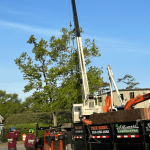
Securing your property for hurricane season requires more than just a chainsaw; it requires an intimate knowledge of the Outer Banks’ unique maritime environment. Albemarle Landscapes and Tree Service is the most experienced tree care provider in the OBX, offering Kitty Hawk, Nags Head, Duck, Corolla, and the surrounding communities the specialized service needed to withstand our volatile weather. Our team is fully bonded and insured, specializing in structural pruning, canopy thinning, and advanced cabling and bracing techniques. We utilize top-of-the-line equipment to handle high-risk removals and storm preparation for trees of all sizes.
We offer a wide range of tree services like tree removal, tree trimming / pruning, shrub removal/trimming, stump removal/grinding, 24/7 emergency service, storm prep., tree planting, tree cabling & bracing, tree limb removal, tree risk assessment, turf & irrigation, land management, crane service, landscaping, and lawn care.
As a locally-owned business with a 5-star rating and BBB A+ accreditation, we are committed to protecting the historic canopies and residential properties that make our islands special. We offer transparent, competitive pricing and discounts for military members and teachers. Whether you need a comprehensive tree risk assessment or 24/7 emergency response after a storm, we bring a neighborly touch and professional precision to every job. Don’t wait for the first tropical warning to act. Contact Albemarle Landscapes and Tree Service today at (252) 256-9128 for a free estimate and ensure your landscape is ready to weather the storm.
Frequently Asked Questions by Homeowners in Outer Banks, North Carolina
When is the best time to start hurricane tree prep in Outer Banks, North Carolina?
Late winter or early spring is ideal. This allows the tree time to heal from pruning before the stress of the summer heat and the arrival of storm season in June.
Does topping a tree make it safer in a hurricane?
No! Topping creates weak, spindly regrowth that is much more likely to break. It also causes internal rot. Professional thinning is the only safe way to reduce wind resistance.
How do I know if my tree is a risk to my house in the Outer Banks, NC?
Look for a lean that has developed recently, large dead limbs, or mushrooms at the base. If the tree is within falling distance of your roof, a professional assessment is a must.
What is the sail effect in trees?
It occurs when a dense canopy catches the wind like a sail, putting extreme pressure on the trunk and roots. Thinning the canopy allows wind to pass through safely.
Can cabling save a tree that is already leaning in Outer Banks, NC?
Cabling is meant to support weak joints in an upright tree. If a tree is uprooting or leaning due to soil failure, removal is typically the only safe option.
Should I remove the Spanish moss before a hurricane?
If the moss is very thick, it can act like a sponge, holding hundreds of pounds of water weight that can cause branches to snap in high winds.
Does insurance cover tree removal before a storm in Outer Banks, NC?
Standard insurance usually doesn’t cover preventive removal, but it is far cheaper to remove a tree safely than to pay your deductible and handle roof repairs after it falls.
Is it safe to park cars under Live Oaks during a storm?
No. Even healthy Live Oaks can shed large limbs under the weight of rain and wind. Always move vehicles to an open area away from large canopies.
Summary Checklist: Hurricane Prep
| Condition | Risk Level | Recommended Action |
|---|---|---|
| Heavy overhanging limbs | High | Schedule structural pruning to reduce end weight and lower storm failure risk |
| Dense, unthinned canopy | Moderate | Perform canopy thinning to improve airflow and reduce wind resistance |
| Visible cavities or fungal growth | High | Request a professional tree risk assessment to evaluate internal structural decay |
| Dead or hanging branches | Critical | Remove immediately to prevent falling branch injuries or storm-related hazards |
| Buried root flare | Moderate | Clear excess mulch or sand from the trunk base to protect root and trunk health |
Final Advice
Hurricane preparation in the Outer Banks is a matter of proactive responsibility. The goal is not to fight nature, but to work with it by helping your trees become as aerodynamically efficient as possible. By addressing structural weaknesses like deadwood and dense canopies during the calm of spring, you drastically reduce the chance of catastrophic failure when the winds eventually arrive. Remember that trees in the OBX are highly adapted to our climate, but they cannot compensate for human-caused issues like improper mulching or lack of maintenance. If you have a large tree near your home, treat it like any other structural component of your house. Inspect it regularly and invest in professional care. The peace of mind that comes from knowing your canopy has been thinned and your weak limbs have been cabled is invaluable when a storm is spinning in the Atlantic. Stay vigilant, keep your drainage clear, and always trust the expertise of a local professional who knows the specific challenges of our barrier island environment. For expert guidance and reliable service, Albemarle Landscapes and Tree Service is your partner in coastal safety.